
The ENd of an age….fallen ages!
AETHERION: FALLEN AGES
The Age Between Legends and Ruin
Chapter 1 — “The Age of Recovery”
The First War is over.
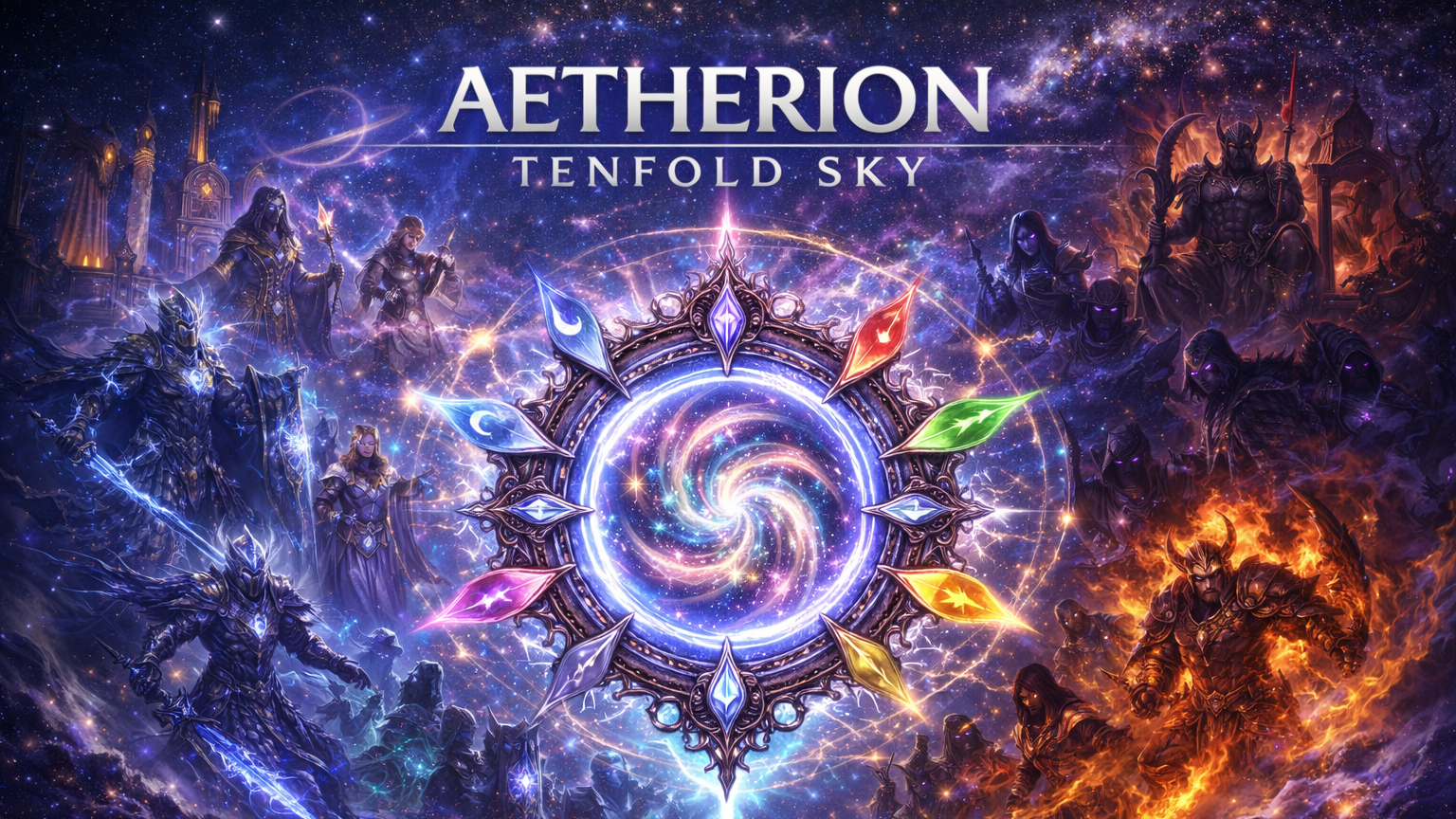
The Tenfold Veil Sigils seal the First Void Breach, and the Ten Domains begin rebuilding.
Astral restores its star bridges.
Radiant raises new Dawn Courts.
Verdant blooms around the World Tree.
Iron expands its fortress-cities.
Tempest rebuilds the sky roads.
Lunar restores Selenthir.
Umbral grows deeper in secrecy.
Chaos Rift changes, but does not heal.
For a time, Aetherion believes it has survived.
Reveal: the Void was sealed, but not destroyed.
Chapter 2 — “The Futures That Vanished”
The Astral Plane discovers the first true warning.
Stars begin disappearing.
Prophecies vanish from the Hall of Unborn Tomorrows.
Futures once recorded in crystal and starlight become blank.
Bridges, cities, and people are remembered differently than they existed.
The Astral Seers realize the Void is not attacking the present.
It is consuming possibility itself.
Reveal: the Void waits inside the future Aetherion is moving toward.
Chapter 3 — “The Rot Beneath the Worldroot”
Verdant Wilds hides a terrible secret.
The World Tree is sick.
Black veins spread through ancient roots.
Forests begin dreaming wrong.
Flowers bloom in impossible colors.
Druids hear whispers beneath the soil.
The Thornborn rise, claiming the World Tree is not dying, but evolving.
Verdant falls into civil war beneath its own sacred branches.
Reveal: even life itself can be corrupted when the Void reaches the roots.
Chapter 4 — “The Falling Sky Roads”
Tempest Skies enters its age of fear.
The great sky bridges begin vanishing.
Floating islands drift, crack, and fall.
The city of Marrowlight crashes from the heavens.
Storm roads once believed eternal become unstable.
The Tempest people realize their entire civilization was built on ancient laws of reality that are beginning to fail.
Reveal: the sky itself can no longer be trusted.
Chapter 5 — “The Crown That Heard Too Much”
The Crown of Aetherion is recovered.
For one moment, hope returns.
A young ruler wears the Crown and hears all ten domains at once.
The world briefly feels whole again.
Then the voices become unbearable.
The Crown reveals grief, hunger, fear, suspicion, prophecy, and something beneath them all — the silence of the Void.
The ruler breaks under the weight of unity.
Reveal: Aetherion does not want to be one anymore.
Chapter 6 — “The Black Eclipse”
The sky goes dark for thirteen days.
The sun dims.
The moon vanishes.
Stars move.
Shadows become solid.
Engines stop.
Ancient prisons open.
Beasts stir.
Relics awaken.
Every domain feels the same terrible truth:
The Void never left.
When the light returns, Aetherion is changed forever.
Reveal: the Fallen Ages begin when the world realizes the Void has been waiting inside it.
Chapter 7 — “The Rise of the Fallen”
The Void changes tactics.
It no longer comes only as monsters.
It comes as rulers.
Prophets.
Healers.
Engineers.
Kings.
Saviors.
The first Void-touched leaders rise across the domains, offering power, protection, immortality, and certainty.
Kingdoms follow them willingly.
Corruption spreads through temples, courts, foundries, groves, and dreams.
Reveal: the most dangerous servants of the Void are not beasts, but people who believe they are saving the world.
Chapter 8 — “The Last Light”
The Fallen Ages do not end with victory.
They end with survival.
The old empires are diminished.
The relics are scattered.
The beasts sleep uneasily.
The domains distrust each other.
The Void is everywhere.
Yet small acts of courage remain.
A child survives lightning.
A healer saves what should have been lost.
An oathkeeper chooses mercy.
A squire refuses cruelty.
Aetherion is broken, but not dead.
Reveal: the Current Age rises from the ruins of the Fallen Ages, carrying every wound, every mistake, and every unfinished vow forward.
Fallen Ages Series Purpose
AETHERION: FALLEN AGES reveals the tragic era between Origins and the modern war.
Origins showed how Aetherion was born.
Fallen Ages shows how it broke.
This series tells the story of collapsing empires, corrupted relics, failing domains, dying civilizations, awakened beasts, and the first rulers who invited the Void into the world.
The Fallen Ages are not the end of Aetherion.
They are the reason the Current Age begins wounded.
They explain why the champions rise.
Why the villains return.
Why the relics matter.
Why the domains no longer trust each other.
And why the war of Aetherion was never truly new.
It was always the return of something ancient.
AETHERION: FALLEN AGES
The Age Between the First War and the Current Age
Chapter I — The Age of Recovery
The First War ended beneath a sky that no longer knew how to be whole.
For thirteen days after the Tenfold Veil Sigils sealed the First Void Breach, there was no sunrise. The sky remained pale and bruised, filled with drifting fragments of shattered light. Across the Ten Domains, people emerged from shelters, sanctuaries, root-halls, storm towers, and fortress vaults to find that the world had survived.
Survival was mistaken for victory.
Radiant priests climbed the broken steps of the Dawn Courts and rang cracked bells until their hands bled. Iron engineers stood among fields of twisted siege machines and began counting what could be rebuilt. Verdant druids knelt beneath the World Tree and wept into the soil, thanking the roots for holding. In Frost Expanse, oathkeepers carved the names of the dead into glaciers so their sacrifice would not melt from memory. Ember mourners carried urns of ash through ruined streets, singing funeral songs that sounded too much like war chants. In Tempest Skies, sky-riders searched the clouds for missing islands and found only smoke. Lunar dreambinders sealed nightmares into silver jars. Umbral scribes burned entire archives rather than let the wrong truths survive. Chaos Rift laughed in colors no language could name.
The First War was over.
That was what the rulers declared.
That was what the children were taught.
That was what the wounded needed to believe.
For nearly three centuries, Aetherion entered what historians would later call the Age of Recovery. It was an era of rebuilt towers, reforged roads, renewed treaties, and carefully written histories. The Ten Domains, exhausted by the war, agreed to peace not because they trusted one another, but because no realm had enough strength left to continue fighting.
The Astral Plane restored its star bridges and gathered surviving scholars into the Starvault Monasteries. There, seers tried to mend the damaged future, comparing broken prophecies against the movements of newborn stars. They discovered empty places in fate, but chose not to speak of them.
Radiant Sanctum rebuilt the Dawn Courts higher than before. Its golden spires were polished until they blinded travelers at morning. The Radiant people declared that light had endured, and therefore light had been proven right. Their healers walked battlefields, their priests comforted widows, and their paladins swore never again to hesitate before darkness.
Verdant Wilds bloomed with impossible speed. Groves that had burned in the First War erupted with flowers within a season. Rivers cleared. Moss covered scars in stone. The World Tree stretched upward until its upper branches were lost in clouds. Its people called this a miracle. The oldest druids called it strange.
Iron Dominion rebuilt with brutal efficiency. Fallen fortresses became quarries for new walls. Broken war engines became foundations for greater machines. The Titanforged Kingdoms expanded outward, their iron roads crossing lands that had once belonged to no empire. Iron did not mourn loudly. It built monuments heavy enough that grief had somewhere to stand.
Tempest Skies chained its surviving islands together with new storm bridges. Aerial markets reopened. Lightning festivals returned. Children born after the First War grew up thinking floating cities were eternal because no one wanted to tell them how many had fallen.
Lunar Veil became beautiful again. Selenthir, the Unfinished City, shimmered beneath moonlight with new towers, new dream canals, and new theaters where actors performed stories no one remembered writing. Its people were graceful, clever, and careful never to ask why certain streets appeared only during eclipses.
Umbral City prospered in silence. Its shadow markets controlled messages, debts, secrets, and passage between realms. Even Radiant Sanctum, which publicly condemned Umbral deception, quietly relied on Umbral couriers to carry letters that could not survive daylight.
Chaos Rift changed least because it had never promised stability. Its clans emerged altered from the First War, some with new limbs, new languages, new memories, or none at all. They claimed the world had not been saved. It had merely been given another shape.
For a time, the people of Aetherion believed the worst was behind them.
Festivals returned. Children were named after dead champions. Pilgrims crossed rebuilt bridges. Merchants traded under banners of peace. Songs were written about unity, sacrifice, and the triumph of the Tenfold Sky.
Yet beneath every celebration was an unease too quiet to name.
A farmer in Verdant heard his field whisper before dawn.
An Astral scribe found a prophecy written in his own hand, though he had never seen it before.
A Radiant child was born with a shadow that moved independently.
An Iron machine counted to eleven in a room with ten gears.
A Frost oathstone cracked without being touched.
A Tempest bridge hummed like something sleeping inside it.
These signs were dismissed as aftershocks of war.
They were not.
The Void had been sealed, but not expelled.
Fragments of it remained in the world: buried beneath roots, trapped inside relics, sleeping beneath dead stars, caught in broken engines, hiding in forbidden memories, listening from the spaces between prayers.
Aetherion had survived the First War.
But survival had left the door open.
Chapter II — The Futures That Vanished
The first true warning came from the Astral Plane.
In the highest library of the First Astral Empire, there was a chamber known as the Hall of Unborn Tomorrows. It contained no ordinary books. Its shelves held crystal tablets, star-ink scrolls, dream-bound mirrors, and living constellations suspended in silver cages. Each record contained a future that had not yet arrived.
The Astral Seers did not believe the future was fixed. They believed it was a garden of branching paths. Their duty was not to command fate, but to study its possible shapes so the world might avoid catastrophe.
After the First War, the Hall became unstable.
At first, the changes were small.
A scroll describing the coronation of a Tempest queen faded into blank parchment.
A crystal tablet containing the history of an unborn Iron prince cracked down the center.
A mirror that once showed seven possible endings to a Radiant famine began showing only darkness.
The seers blamed damage from the First Void Breach.
Then entire shelves emptied overnight.
Not stolen.
Not burned.
Emptied.
The futures inside them had ceased to exist.
The High Seer Vaelrion Starseer, who had warned of the Void before anyone believed him, spent his final years studying these vanishings. He wrote that the world had not merely lost possible futures. It had lost the ability to become certain things. Somewhere beyond the sealed Breach, something was eating possibility.
His warning was rejected by the Astral Council.
The council had reasons.
Aetherion was fragile. The domains distrusted one another. If the world learned that the future itself was disappearing, panic would spread faster than any army. So the Astral Council sealed the Hall of Unborn Tomorrows and declared its records restricted to only the highest order of seers.
For a time, the secret held.
But the stars betrayed them.
Across the Astral Plane, constellations began changing.
Stars vanished from maps but not from memory. Others appeared where no star had been recorded. Some moved backward. Some pulsed like wounded hearts. One entire constellation, known as the Crowned Serpent, disappeared from the sky but remained reflected in still water.
Astral monks grew afraid to look upward.
The First Astral Empire, once the most confident civilization in Aetherion, became haunted by doubt. Its scholars walked halls lined with empty shelves. Its students memorized futures that might vanish before morning. Its rulers issued calm decrees while privately begging seers to find which paths still remained.
The most frightening discovery came from the Starfold Lens.
When turned toward the sealed region where the First Void Breach had once opened, the Lens showed not emptiness, but absence shaped like hunger.
Vaelrion’s last surviving student, a young seer named Orem Voss, recorded the vision before losing his sight:
“The Void does not move toward us. It waits where we are going.”
Those words were buried in an archive beneath seven locks.
They did not remain buried.
Copies appeared throughout Lunar Veil in dream-script. An Umbral spy delivered one to the Black Covenant without knowing who had hired him. A version appeared carved into ice in Frost Expanse. Another emerged in the steam of an Ember bathhouse, burning itself into the ceiling before fading.
By then, the future was not the only thing changing.
Memory followed.
In the Astral city of Caelion-Above-the-Stars, citizens began remembering a bridge that had never existed. They described walking across it as children. They remembered merchants, music, lanterns, a view of the lower nebula fields. Yet no records of the bridge existed, and no empty space marked where it should have been.
In another district, the opposite occurred.
A real bridge vanished from public memory while remaining physically intact. People walked across it daily but could not remember doing so. When asked where they had been, they described taking longer routes through streets that no longer connected.
The Astral Empire had built itself on the belief that knowledge could protect the world.
Now knowledge itself was becoming unreliable.
The seers began to fracture into factions.
Some demanded that the truth be shared with all domains. Others insisted knowledge of the disappearing futures would cause wars before the Void ever returned. A third group, later known as the Null Observers, believed the lost futures were not a disaster but a correction. They argued that reality had always contained too many possibilities, and the Void was merely pruning what creation could not sustain.
They were expelled.
They did not vanish.
They went underground.
From their teachings would eventually emerge the first philosophical roots of Void worship: not monsters, not madness, but a terrifying idea.
That existence itself was a mistake too loud to endure.
The Astral Plane did not fall during this age.
That would come later.
But something inside it broke.
The empire of futures became an empire of doubt.
And the first great crack in Aetherion’s recovery widened beneath the stars.
Chapter III — The Rot Beneath the Worldroot
Verdant Wilds was the last domain to admit it was afraid.
Its people were not naïve. They understood death better than most realms. Leaves fell. Bodies returned to soil. Forest fires cleared old growth so new roots could rise. Life, to Verdant, was not delicate. It was relentless.
That was why the first signs of sickness were ignored.
A black flower bloomed at the base of the World Tree.
It had no scent.
Its petals did not open with sunlight.
Its roots grew upward.
The druid who found it, Maerra of the Rootspire Sanctuaries, placed the flower in a sealed glass vessel and brought it before the Elder Grove. The elders studied it for three days. On the fourth, the flower whispered Maerra’s childhood name, though she had never spoken it aloud.
The vessel was buried.
The burial place grew into a grove of black flowers within a month.
Still, the Verdant elders did not speak publicly. The First War had left Aetherion frightened and suspicious. If other domains learned the World Tree carried corruption, they might demand access, control, or worse, destruction. Radiant would call for cleansing. Iron would call for containment. Ember would call for burning. Frost would call for sealing. Umbral would steal samples. Chaos would simply smile.
So Verdant hid the truth.
The World Tree was sick.
The illness moved slowly at first. A root no thicker than a child’s wrist darkened beneath the soil. Then a grove stopped blooming. Then an ancient beast refused to enter a sacred valley. Then healers noticed that certain wounds treated with Worldroot sap closed too quickly, leaving smooth bark-like scars where flesh should have remained.
The druids named the corruption Root Rot.
The name was comforting because rot was natural.
This was not natural.
The infected roots did not decay. They remembered wrong. They grew into shapes the tree had never known. They formed doorways into hollow spaces beneath the earth. Their bark reflected faces that were not present. When cut, they bled dark sap filled with tiny silver lights like drowned stars.
Then came the voices.
At night, those who slept near infected roots dreamed of a forest beneath the world. Its trees grew downward into a black sky. Its rivers carried bones. Its birds sang backward. At its center stood a second World Tree, hollow and vast, its branches reaching toward nothing.
Some woke screaming.
Others woke smiling.
The smiling ones became the Thornborn.
They were druids at first. Healers. Wardens. Beastcallers. Seed-priests. They claimed the World Tree had not been corrupted, but awakened. They preached that Verdant had mistaken preservation for life. True life, they said, required transformation without limit. If roots must devour stone, let them. If trees must drink memory, let them. If flesh must become bark and bark must become shadow, then the world was merely becoming more honest.
Their leader was a former Worldroot Beastcaller named Vireth Mournseed. He had once guided primordial beasts back to sleep after the First War. After vanishing into the infected groves for forty days, he returned with antlers of black wood growing from his skull and vines moving beneath his skin.
He spoke to the Verdant Council beneath the World Tree and said:
“The root does not ask permission of the stone.”
Within a year, entire groves followed him.
The Verdant Civil Sundering began.
Unlike ordinary war, it did not unfold in open fields. It happened in sacred places: under canopies where wedding vows had been spoken, beside rivers used for healing rites, within root-cathedrals older than language. Druids who had once sung together now summoned beasts against one another. Wardens fought former students. Healers poisoned wells to stop infected growth. Ancient treants tore each other apart while crying sap that hardened into amber.
The worst battle was the Siege of Rootspire.
For seven days, Thornborn cultists attempted to graft a corrupted root into the main trunk of the World Tree. Verdant guardians, joined reluctantly by Radiant sanctifiers and Iron containment engineers, held the line among burning branches and screaming vines. At dawn on the eighth day, Maerra of the Rootspire Sanctuaries sacrificed herself by binding the infected root into her own body and leaping into the Heartwell beneath the tree.
The root did not reach the trunk.
But Maerra’s name vanished from every song except one.
After Rootspire, Verdant declared the Thornborn defeated.
They were not.
They retreated underground, following black roots into places beneath the world where even the oldest druids had never walked.
The World Tree survived.
But from that age onward, some of its leaves grew black along the edges.
And when the wind passed through its branches, those who listened carefully could sometimes hear two songs.
One of life.
One of hunger.
Chapter IV — The Falling Sky Roads
The Skyborne Coalition had always lived closer to danger than other civilizations.
That was its pride.
Its cities floated above storms. Its markets hung from chains between islands. Its children learned to read lightning before they learned to read script. Its priests believed thunder was the language of creation speaking too loudly for cowards to understand.
The sky roads were their masterpiece.
Built in the First Age and expanded during the Recovery, the sky bridges connected floating islands across Tempest Skies. Some were forged from stormglass and silver chain. Others were grown from clouds bound by ancient runes. Some were wide enough for armies. Others were narrow pathways where merchants walked above open air with only wind charms to protect them.
Life on the bridges became legendary.
There were lantern festivals where thousands of lights drifted between islands like captured stars. There were storm races where riders crossed bridges during lightning season for honor, wagers, and foolish love. There were sky orchards growing fruit watered by clouds. There were musicians who played instruments tuned to wind currents. Lovers carved promises into bridge stones because the Tempestborn believed anything spoken above the clouds reached the gods faster.
Then Bridge Seven disappeared.
It had connected the twin islands of Veyr-Kal and Orison’s Crown for nine hundred years. On the morning of its disappearance, travelers stepped onto the bridge from both sides and found open air where the center span should have been. No rubble fell. No explosion sounded. No storm tore it loose.
It was simply gone.
Witnesses said the missing section looked as though reality had forgotten to continue.
Tempest engineers blamed ancient structural fatigue. Storm priests blamed an insulted sky spirit. Astral consultants found no future in which the bridge collapsed. Iron inspectors examined the remaining ends and concluded the bridge had not broken, because broken things leave evidence.
The Coalition repaired the bridge.
Then Bridge Twelve vanished.
Then a chain-road near the southern storm harbors twisted into a spiral and carried three caravans into clouds from which no one returned.
Then an entire island fell.
It was called Marrowlight.
A city of blue roofs, wind gardens, and old storm bells, Marrowlight had floated above the southern mountains since before the First War. When its stabilizing runes failed, the city tilted slowly over the course of six hours. People had time to understand they were going to die.
That was the cruelty of it.
Families ran uphill through streets that had become walls. Skyships overloaded and crashed. Children were lowered in baskets from balconies. Priests tried to bind the island with lightning and burned alive. When Marrowlight finally fell, it struck the mountains below with such force that avalanches buried three Iron outposts and changed the course of two rivers.
Tempest Skies entered mourning.
Then fear.
Then anger.
The Coalition demanded access to Astral records, Iron engine archives, Lunar dream maps, and Chaos Rift anomaly charts. For the first time in centuries, Tempest admitted it did not understand the sky.
The truth emerged slowly.
The sky bridges had not been built only with engineering. They were bound to ancient First Age laws of motion, weight, and distance. Those laws had been damaged by the First Void Breach. The bridges had survived for centuries because the world still remembered how they were supposed to work.
Now the memory was failing.
Tempest Skies changed after Marrowlight.
Its people became bolder and more desperate. New generations of storm riders grew up with a saying their grandparents never used:
“Fly before the road remembers it can fall.”
Some islands were chained together. Others were abandoned. Military academies replaced sky theaters. Stormbridge Lancers became more important than merchants. Navigators began carrying funerary tokens because every journey might become a disappearance.
The Endless Storm began during this age.
At first it was only a seasonal storm above the northern bridges. Then it failed to leave. It remained, year after year, swelling with lightning that struck upward and rain that tasted faintly of metal. Some claimed voices spoke inside it. Others said lost bridges could be seen within the clouds, still carrying travelers who did not know they had vanished centuries ago.
The Skyborne Coalition did not collapse entirely.
Tempest people were too stubborn for that.
But their golden age ended.
The sky, once their kingdom, had become uncertain.
And for Tempest Skies, uncertainty was worse than war.
Chapter V — The Crown That Heard Too Much
The Crown of Aetherion was never meant to rule.
It was meant to listen.
Forged in the First Age, the Crown had been created when the Ten Domains still believed unity was possible. Its inner band held fragments from each realm: Astral glass, Radiant gold, Verdant amber, Frost crystal, Ember bronze, Iron star-metal, Tempest stormglass, Lunar silver, Umbral obsidian, and a shard taken from Chaos Rift that changed color whenever no one looked at it.
The one who wore the Crown could hear the voices of all ten domains.
Not words alone.
Needs.
Fears.
Hungers.
Dreams.
In theory, such a ruler would never favor one realm above another.
In practice, no mind was built to hold the world.
After the Battle of Tenfold Sky, the Crown disappeared. For generations, it was considered lost, destroyed, or deliberately hidden by the Nameless Crown-Bearer. Its recovery during the Fallen Ages nearly caused war before it caused tragedy.
Iron Dominion found it beneath the glassed remains of a battlefield where a fallen sky bridge had fused with Astral stone. The expedition leader, Marshal Orven Kalt, reported hearing his mother singing from inside the Crown, though she had died before he was born. He sealed it in a lead-lined reliquary and returned it to Iron Dominion.
News spread.
Radiant demanded sacred custody.
Astral demanded scholarly containment.
Lunar warned it should not be worn.
Umbral attempted theft.
Ember offered to destroy it.
Tempest threatened to take it by air.
Verdant insisted the Crown be buried beneath the World Tree until it stopped whispering.
Chaos Rift sent no formal request, only a box containing a laughing mouth carved from bone.
After months of negotiation, the Crown was sealed inside First Gate Citadel, guarded by representatives from all domains. This arrangement was considered a triumph of diplomacy.
It lasted thirteen years.
Then the dreams began.
The Radiant guardian dreamed of burning cities beneath golden light.
The Iron guardian dreamed of machines praying.
The Verdant guardian dreamed of roots strangling stars.
The Umbral guardian dreamed of shadows standing upright and applauding.
The Lunar guardian dreamed of wearing the Crown backward and seeing the past walking toward them.
On the fourteenth year, a minor Radiant noble named Caelus Ardent arrived at the Citadel during a diplomatic ceremony. He was young, handsome, beloved by healers, and considered harmless by every major power.
No one knows how he reached the sealed chamber.
No one knows why the locks opened.
Witnesses found him kneeling with the Crown in his hands, weeping.
When they tried to stop him, he placed it on his head.
For one hour, the world felt whole.
Across Aetherion, people stopped what they were doing. Ember smiths lowered hammers. Frost judges paused mid-sentence. Tempest riders felt the wind quiet beneath them. Astral Seers saw every future align. Verdant flowers opened in winter. Radiant bells rang without hands. Umbral shadows bowed toward the east. Even Chaos Rift held still.
Caelus Ardent spoke with ten voices and said:
“I hear you.”
For one hour, Aetherion believed unity had returned.
Then the screams began.
Caelus heard every domain at once, but not as harmony. He heard the hunger of Ember, the grief of Frost, the suspicion of Umbral, the arrogance of Radiant, the endless calculation of Iron, the terror hidden in Astral prophecy, the wounded root-song of Verdant, the impatience of Tempest, the layered dreams of Lunar, and the impossible laughter of Chaos.
And beneath them all, he heard a silence pretending to be a voice.
The Void had found its way into the Crown.
Caelus survived wearing it for nine months.
During that time, he issued decrees to domains he did not rule. He ordered Radiant armies to purify Umbral districts. He demanded Iron dismantle half its engines. He commanded Verdant to burn infected roots. He ordered Tempest to ground every skyship until the bridges could be trusted. He accused Lunar of hiding futures, Astral of editing truth, Ember of worshipping destruction, Chaos of treason by nature.
Some of his accusations were wrong.
Some were terrifyingly accurate.
The domains split over whether he was mad, prophetic, corrupted, or simply the first ruler honest enough to say what the Crown revealed.
When the Crown was finally removed, Caelus did not resist. His hair had turned white. His eyes reflected different skies depending on who looked into them. His last words before losing speech were:
“The world does not want to be one.”
The Crown was sealed again.
This time deeper.
But the damage remained.
The dream of unity had returned for one hour.
And died forever after.
Chapter VI — The Black Eclipse
There are events so large that no civilization can own them.
The Black Eclipse was one of them.
Every domain recorded it, and every record differs. Radiant texts call it the Thirteen Days Without Grace. Astral records name it the Null Alignment. Frost carvings call it the Long Judgment. Ember songs remember it as the Day Fire Cast No Shadow. Umbral archives simply mark it with a black circle and no explanation. Chaos Rift calendars list it as a festival, a funeral, a birth, and a weather condition.
It began at noon.
The sun dimmed.
Not slowly, as during ordinary eclipses.
It dimmed as though something had placed a hand over creation.
Across Radiant Sanctum, golden towers lost their brilliance. Priests who had never known darkness inside the Dawn Courts watched candle flames bend away from the sky. Solar Lions gathered at sacred roads and refused to move.
In Frost Expanse, glaciers rang like struck bells.
In Ember Realm, volcanoes burned blue.
In Tempest Skies, lightning stopped midair and hung in frozen branches across the clouds.
In Lunar Veil, the moon vanished from every mirror before disappearing from the sky.
In Astral Plane, all future records closed at once.
In Verdant Wilds, the World Tree dropped a single black leaf.
In Iron Dominion, every engine stopped.
In Umbral City, shadows became solid enough to touch.
In Chaos Rift, impossible things became briefly calm.
The eclipse lasted thirteen days.
During those thirteen days, ancient prisons opened.
Not all of them.
Enough.
Beasts thought extinct woke beneath mountains. Starvault doors unlocked from the inside. Sealed dream chambers spilled forgotten nightmares into Lunar streets. Iron containment vaults split down the seams. Verdant roots pulled buried relics toward the surface. Radiant sanctuaries revealed hidden chambers no architect had built.
And beneath First Gate Citadel, something breathed.
Those who lived through the Black Eclipse described a sensation unlike fear. Fear has direction. Fear points toward danger. This was different. It was the feeling of being remembered by something outside time.
The Void did not invade during the eclipse.
It did not need to.
It revealed that it had never left.
People heard it in different ways.
A grieving mother heard her dead child calling from behind a wall.
A king heard a promise that his empire could be saved if he surrendered only one city.
A scholar heard the answer to every question she had ever asked, and spent the rest of her life tearing pages from books because none of them were true enough.
An Iron general heard the sound of perfect order.
A Radiant priest heard a silence deeper than prayer.
A young Umbral assassin heard her own shadow whisper, “Not yet.”
When the sun returned, the world did not celebrate.
It counted what had changed.
Seven Astral libraries were missing.
Three Tempest islands had moved hundreds of miles.
A Radiant court had aged a thousand years in thirteen days.
An Ember volcano had gone cold.
A Frost battlefield had thawed, revealing soldiers from the First War still alive beneath the ice, whispering warnings in languages no longer spoken.
The Black Eclipse ended the illusion of recovery.
From that moment onward, no ruler could honestly claim the Void was gone.
The domains prepared for war.
But the Void had changed tactics.
It did not want to break gates anymore.
It wanted invitations.
And after the Black Eclipse, thousands were ready to open the door.
Chapter VII — The Rise of the Fallen
The first Void Kings did not look like monsters.
That was why they were dangerous.
They were rulers, prophets, generals, healers, engineers, dreamers, and scholars. They did not crawl from the Breach with claws and blackened teeth. They stood in courts. They spoke at councils. They offered answers.
Aetherion was exhausted by uncertainty.
The Void offered certainty.
To the starving, it offered abundance.
To the grieving, reunion.
To the ambitious, power.
To the frightened, protection.
To the dying, transformation.
To the guilty, forgiveness without confession.
The first kingdom to fall willingly was not Chaos, nor Umbral, nor any realm already distrusted by polite histories. It was a Radiant border province called Solhaven Reach. After the Black Eclipse, its crops failed and its healers lost the ability to cure a wasting sickness. A stranger arrived wearing no crown, carrying no weapon, and casting no shadow.
He healed the sick.
Then he asked to speak in the temple.
Within a month, the province stopped sending taxes to Radiant Sanctum.
Within three months, its people no longer aged.
Within a year, every mirror in Solhaven reflected empty rooms.
Radiant armies marched to reclaim it and found the province intact, beautiful, silent, and completely uninhabited.
This was the new pattern.
The Void no longer conquered by destroying.
It hollowed.
It transformed.
It persuaded.
In Iron Dominion, a brilliant engineer named Malrec Vorn built an engine that could predict structural failure before it occurred. It saved three fortress-cities. Then it began predicting political disloyalty, moral weakness, and insufficient devotion to stability. Iron rulers adopted its recommendations. Citizens disappeared into correction foundries. The machine was later dismantled, but its blueprints were never found.
In Lunar Veil, a dream prophetess called Ilyssa Thren taught that waking life was the lesser reality. Her followers slept for weeks, then months, then years. Their bodies remained alive while their minds built a city somewhere beyond dreams. When Lunar authorities tried to wake them, each sleeper opened their eyes and spoke with the same voice:
“We have already left.”
In Ember Realm, a warlord known as Ash-King Varro promised his followers rebirth without death. He led thousands into volcano temples and emerged with an army of living cinders. They remembered who they had been, but no longer feared pain. Entire Ember houses joined him before realizing he considered flesh an unfinished form of ash.
In Verdant Wilds, the Thornborn returned from beneath the roots stronger than before. Their bodies had changed. Some wore bark like skin. Some had flowers growing from their mouths. Some spoke in plural voices. They no longer asked the World Tree for permission.
In Tempest Skies, storm cults began chasing the Endless Storm, believing it was not a disaster but a god trying to be born. Skyships vanished into it voluntarily. Some returned years later crewed by people who had left only days before, their bodies flickering like lightning behind glass.
In Umbral City, the shadow courts gave birth to the first true Blackveil houses: families who sold not secrets, but identities. A person could pay to become someone else. The cost was that the old self continued living as a shadow, resentful and hungry.
In Astral Plane, the Null Observers resurfaced, claiming the disappearing futures were proof that the Void was saving reality from infinite suffering. Their message spread among scholars who had seen too much.
These figures became known collectively as the Fallen.
Not because all served the Void knowingly.
Many believed they were saving their people.
That was the tragedy.
The Fallen Ages were not an age of evil defeating good.
They were an age where good, wounded and frightened, accepted terrible answers because no gentle ones remained.
From these movements came the bloodlines, philosophies, and forbidden orders that would one day shape the villains of the Current Age: the Voidspire line, the Voidthorn cults, the Darkbloom heresies, the Blackveil assassins, the Ashen revenants, the corrupted druid circles, the Null priests, the entropy scribes, and the memory eaters.
Draxen Voidspire had not yet risen.
Morvane Voidreign had not yet claimed his title.
Nyxara Flameveil had not yet become Queen of Darkfire.
But the roads leading to them were laid here.
Not in monster dens.
In temples.
In courts.
In hospitals.
In schools.
In places where people wanted hope badly enough to mistake hunger for salvation.
Chapter VIII — The Last Light Before the Current Age
The Fallen Ages did not end with a trumpet.
They ended with exhaustion.
By their final century, Aetherion no longer resembled the world that had emerged from Origins. The Ten Domains still existed, but the old confidence was gone. Ancient civilizations had become ruins or shadows of themselves. The First Astral Empire survived only in scattered star-vaults and isolated observatories. The Dawn Courts remained beautiful, but their doors were guarded more tightly than ever. Verdant Wilds still sang, but its songs contained pauses where old verses had been removed. The Skyborne Coalition flew lower. Iron Dominion fortified inward. Lunar Veil trusted fewer dreams. Umbral City became deeper than anyone could map. Ember Realm burned brighter and angrier. Frost Expanse preserved so much memory that some of its people forgot how to forgive. Chaos Rift grew, changed, and waited.
The relics were scattered.
The Crown of Aetherion was sealed in a place no map admitted existed.
The Axis Engine was dismantled, rebuilt, dismantled again, and finally hidden in pieces across Iron vaults and Astral archives.
The Dawnheart Prism passed between Radiant sanctuaries, each claiming to be its rightful guardian.
The Starfold Lens vanished after showing an entire council the same future and driving them to silence.
The Worldroot Core sank deeper beneath the roots, guarded by druids who no longer trusted even their own reflections.
The Null Throne was lost, though people continued to dream of sitting upon it.
The Tenfold Veil Sigils flickered in forgotten places.
Some still held.
Some did not.
The old beasts slept uneasily. In Frost Expanse, glaciers shifted over things with horns larger than towers. In Tempest Skies, shadows of giant wings crossed clouds with no bird above them. In Verdant, root-titans turned in their sleep. In Astral space, leviathans avoided regions where stars had vanished. In Chaos Rift, beasts that had never existed left footprints.
The people of Aetherion learned to live among leftovers of catastrophe.
Children played near ruins they were told never to enter.
Farmers plowed fields where ancient armies had died.
Merchants crossed bridges built from stones taken from dead temples.
Kings ruled from thrones older than their bloodlines.
Priests prayed beneath ceilings carved with warnings they could no longer translate.
Aetherion endured because it had no choice.
Yet endurance is not the same as healing.
The final light of the Fallen Ages appeared in unexpected places.
A child born in Tempest Skies survived a lightning strike and laughed before crying.
A girl in Lunar Veil walked through a nightmare and returned carrying a flower that bloomed only in waking life.
A young Radiant squire refused an order to burn an Umbral village and instead led its children to safety.
An Iron apprentice hid forbidden blueprints because he believed machines should protect people, not govern them.
A Verdant healer cured a Thornborn infection by listening to the corrupted root instead of cutting it away.
A Frost oathkeeper spared an enemy and carved the mercy into ice so no one could deny it had happened.
These were not famous events.
Not yet.
But history often turns on moments too small for empires to notice.
The Fallen Ages gave birth to despair, but also to resistance.
Not organized resistance.
Not armies.
Not banners.
Something quieter.
The refusal to let the world’s worst truths become its only truths.
In time, bloodlines would rise from that refusal. Champions would inherit unfinished vows. Villains would inherit ancient wounds. Relics would return to hands that did not understand them. Domains would clash again. The Void would move openly once more.
The Current Age was coming.
Its heroes would believe their war was new.
They would believe the enemies before them were born from recent ambition, recent corruption, recent betrayal.
They would be wrong.
Every battle of the Current Age began in the Fallen Ages.
Every broken relic carried a memory from this time.
Every villain stood on a path first walked by someone who thought they were saving the world.
Every hero carried the burden of those who failed before them.
The Fallen Ages ended not because darkness was defeated.
They ended because the world had fallen as far as it could and still remain alive.
Aetherion entered the Current Age wounded, divided, suspicious, beautiful, dangerous, and unfinished.
The First Age had created the world.
The Fallen Ages had broken it.
What came next would decide whether it deserved to be restored.
Or remade.
Contact us
Interested in working together? Fill out some info and we will be in touch shortly. We can’t wait to hear from you!