official game rules
Printed cards and this rulebookPrinted cards always take priority
These are the official rules for AETHERION AXIS. Printed card names, types, costs, stats, durability and abilities govern their effects.
Read the actual printed gameplay face. An explicit card instruction overrides a general default for its stated subject. An explicit absolute cap defeats ordinary increases to that subject. The rules below define timing, recipients and interactions; they do not erase an explicit printed instruction. If a printed card explicitly conflicts with a general rule, follow the printed instruction for its stated effect.
The Heart of Aetherion and The Tenfold Veil Sigils have their ability definitions below. Rarity is a lore classification only.
Beginner quick startA quick way to begin your first match
Build a deck of at least 30 cards with no more than two of the same printed name and no more than two Weapons total, regardless of name. Choose your Active Domain, determine who starts, shuffle, and draw three cards if first or four if second. Begin at 30 Health.
On your first personal turn, receive 1 Aether and draw one card. Play affordable cards, then enter Attack phase. Older Units, or Units with Haste, may attack; a hero with a Weapon may attack using its printed Attack, spending one of its 3 Durability. Finish end effects and pass the turn. Reduce the opposing hero to zero Health to win. Detailed targeting and timing below apply.
Deck building and rarityTwo copies per printed name; rarity is lore-only
A deck contains at least 30 physical cards. There is no maximum; 30–40 is recommended. The maximum is two copies of the same printed name, including Legendary and Mythic, regardless of rarity. Weapon limit: a deck may contain no more than two Weapon cards in total, regardless of their printed names. These count toward the normal deck size and per-name limit. A deck may contain zero or one Weapon if preferred. Rarity describes lore importance, never strength, strategic value or mechanical power.
Count the same printed name across sets, artwork and printings together. Different printed names count separately. Ignore letter case and accidental repeated/outer spaces; retain meaningful punctuation and subtitles. Resolve disputed identities from the physical cards or an approved publisher mapping. Generated tokens and Echo copies do not count toward deck construction limits.
There are no additional Domain deck restrictions, sideboards or opening mulligans in this format. No restriction may be inferred from a card’s lore tier.
Setup, Active Domains and victoryChoose a Domain, draw your hand, begin at 30 Health
Each hero begins at 30 Health and has maximum Health 30 unless an explicit card says otherwise. Before drawing opening hands, each player publicly declares one Active Domain: Verdant, Ember, Umbral, Tempest, Radiant, Iron, Astral, Lunar, Chaos/Void, or Frost. Chaos and Void here identify the same Domain, not two separate choices. Use printed Domain labels or an approved publisher mapping; never infer a Domain from artwork, names or rarity. Each selection remains fixed for the match and does not restrict the deck.
Determine the actual first player by an agreed random method. Assign decks independently of starting position, shuffle each deck, then draw opening hands: first player three cards, second player four. Opening hands are separate from turns. The first player still draws during the first Draw phase. Players alternate complete turns.
After each indivisible event, a hero at zero or less Health loses immediately. If the same simultaneous event leaves both heroes at zero or less, the game is a draw. Do not resolve later triggers, healing or draws after the result is decided.
A player who must draw from an empty deck immediately loses. An empty deck without a required draw is not a loss. Draw multiple cards one at a time; the first failed draw ends the game. If an instruction has both players draw, the active player draws first, followed by the other player. A later failure does not turn an earlier deck-exhaustion loss into a draw.
Card types, zones and board limitsBoard limits and public information
Units have printed Attack and Health and remain until removed. Weapons equip the hero and use their printed Attack and abilities. All ten Weapons begin with 3 Durability. Relics remain in their slot and provide their stated effects. A World supplies the single shared global effect.
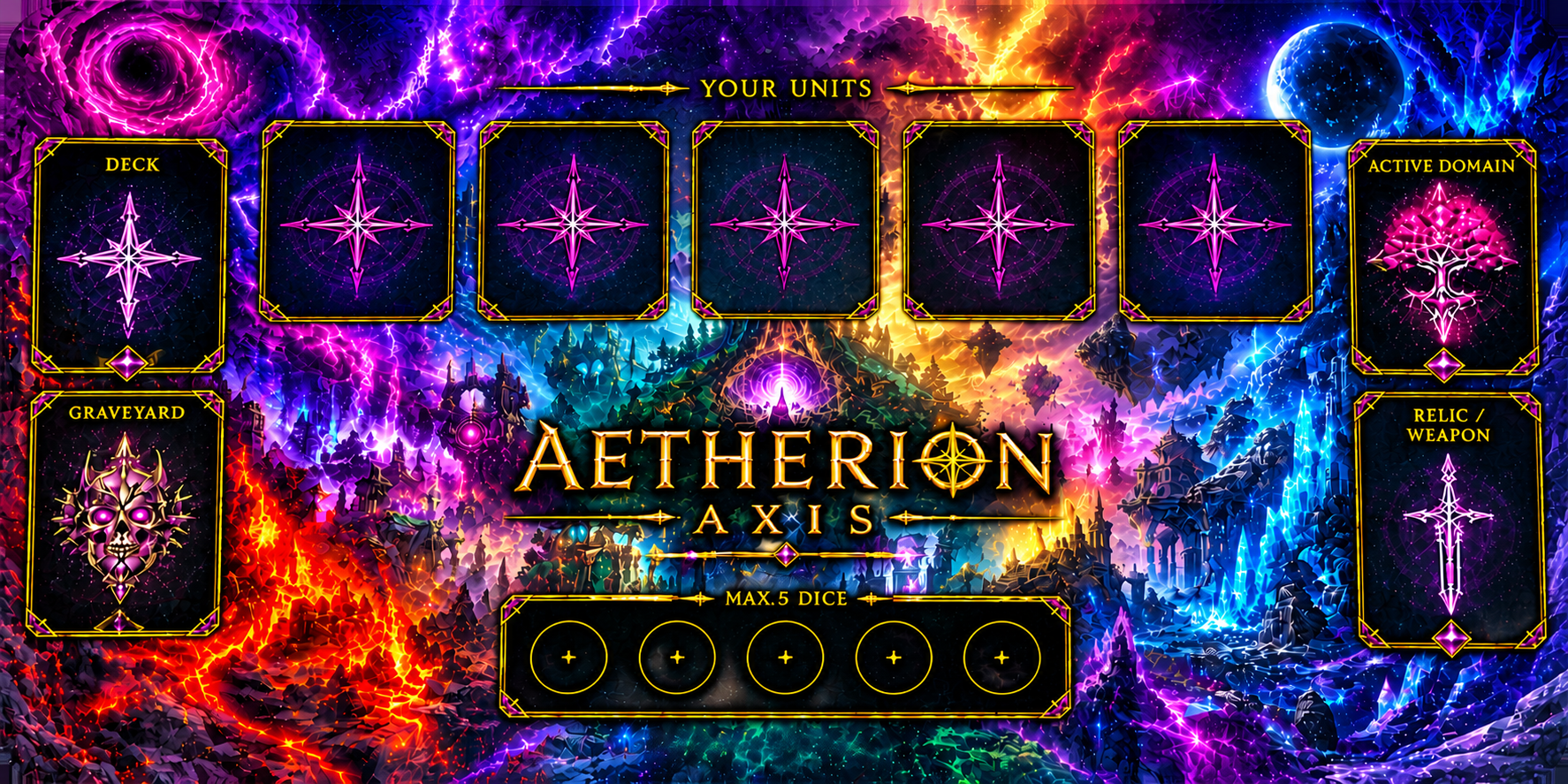
Each player may include at most two Weapons in their deck and may equip only one at a time. Each player has a face-down deck, private hand, battlefield, Weapon slot, Relic slot and Graveyard. Maximums are five Units, one Weapon and one Relic per player, and one World shared by both players. Stealth restricts targeting, not knowledge of the Unit’s identity. Battlefield identities, stats, statuses, hero Health, Aether, equipment, World, hand/deck counts and Graveyards are public. Opponent hand identities and hidden deck order remain private unless an effect explicitly reveals them.
All physical cards entering a Graveyard are face up, including discarded cards. Either player may inspect either Graveyard. This face-up rule also applies when the discarded card was previously private. Cards go to their owner’s Graveyard. Owner means the player whose starting deck contained that physical card; controller means the player currently operating it.
A generated token or Echo copy ceases to exist when it leaves the battlefield; do not add it to a physical hand, deck or Graveyard. Its creation and removal are public. No player may inspect a hidden zone without an explicit rule or card instruction.
Aether and turn structureOpen for full ruling
At the beginning of a player’s first personal turn, set maximum and available Aether to 1. On each later personal turn, increase that player’s maximum by one, to a maximum of 10, then refill available Aether. Opponent turns do not advance your maximum. Unspent Aether becomes zero at your end phase; maximum Aether remains.
At turn start, reset each-turn allowances and first-event markers for the new global turn. Refresh only the active player’s Unit attacks, activated Actions and hero attack. Reset first-damage prevention for both sides. Controller-turn allowances reset for that controller’s turn. Replacing a card never retroactively restores an already-used first-event position.
Draw phase: draw one card, applying explicit draw modifiers; finish the draw and its compulsory consequences. Then resolve The Heart of Aetherion’s supplemental choice if it was already equipped when this Draw phase began and remains equipped. Stop immediately if the draw or its consequences ended the game.
Play phase: play affordable cards and use permitted activated Actions in any order. Pay each printed play cost once. Only a card in your hand may be played. Pay an activation cost only if explicitly specified; no generic extra Aether charge is added. Resolve each play/Action fully before the next.
Attack phase: declare and fully resolve attacks one at a time. You may pass. You cannot return to Play phase, voluntarily play cards or use Actions here unless explicit printed text permits it. End phase follows the ordered steps below. There is no general opponent interrupt or response window.
Playing cards and replacementsOpen for full ruling
A Unit requires an open Unit slot. Put the paid card into play, then resolve On Play. When fewer legal On Play recipients exist than specified, choose as many distinct eligible recipients as possible and resolve the possible parts. The Unit may enter even if no recipient exists. Never select an illegal target or reuse one target to fill two distinct-target positions. A reusable targeted Action with no legal target is unavailable; entry permission is not permission to activate an empty Action.
A newly played Weapon may replace the equipped Weapon: pay the new Weapon’s printed cost and put the old physical card face up into its owner’s Graveyard. The new Weapon starts with 3 Durability and no previous instance bonuses. Replacement never refreshes the hero’s attack. There is no free voluntary discard/removal action. A Relic cannot be played into an occupied Relic slot unless an explicit effect permits replacement or first removes it.
A new World replaces the old World, sending the old physical card face up to its owner’s Graveyard. Only the new World remains active, even if both have the same name. Remove old continuous bonuses and apply new ones as one replacement update, preserve damage, and resolve resulting casualties before continuing. Do not create an artificial gap in an unchanged same-value Health aura.
Targeting, Guard and StealthWho can be targeted and how protection works
An unspecified single-target damage ability chooses one enemy hero or enemy Unit. Unspecified healing chooses a friendly hero or Unit. Burn, Freeze, Void, Silence and Unit stat changes affect Units only unless explicit text says otherwise. Unspecified Silence or Void chooses one enemy Unit. A Relic defaults to its controller’s side; Worlds affect both sides according to their recipient clauses.
“All enemies” includes the enemy hero for damage and enemy Units for applicable effects; Unit-only statuses never apply to a hero. “All allies” includes the controller’s hero for healing and all eligible friendly Units, including the source. “All Units” includes both sides and the entering source, excluding heroes. “Another ally” excludes the source instance, not every copy of its name. Do not infer equipment, hand, deck or World targeting from a Unit-only instruction.
Guard restricts Unit and hero Weapon attack declarations, not damage abilities or other nonattack effects. If an unsilenced enemy Guard exists, an attack may choose only an otherwise targetable enemy Guard. An unrevealed Stealth Guard still blocks other targets but cannot itself be selected. If there is no targetable Guard, no attack is legal; use an eligible nonattack effect or pass.
Unrevealed Stealth cannot be selected by either player for a targeted attack, heal, buff or other chosen effect. It can be affected by untargeted area/all-recipient effects and automatic rules. A Stealth Unit reveals on declaring an attack, even if damage is prevented, and stays revealed. Silence removes Stealth.
Choose recipients when an effect reaches resolution, using current state. Recheck a locked attack target after On Attack effects. If it left play or became illegal, do not retarget: the attack and durability use remain spent, earlier effects remain resolved, and ordinary exchange is cancelled. Mandatory legal choices cannot be skipped.
Simultaneous effects, deaths and loopsOpen for full ruling
Treat a single instruction’s simultaneous damage to all recipients as one packet. Combat exchange and an area-damage instruction are each atomic: determine all amounts, apply Health losses together, then remove casualties as a batch. “Deal damage, then draw” contains separate ordered instructions, not a simultaneous event. Complete an atomic event even if a recipient reaches zero during its application.
After each event or instruction, update continuous effects, collect Units at zero or less Health, snapshot eligible death abilities/observers before removal, remove that casualty batch, and repeat casualty checks if aura loss produces further casualties. Check hero victory before executing queued death triggers. Suppressed abilities on a Unit already Silenced at death create no trigger.
Order simultaneous triggers by the active player’s sources first, then the other player’s sources; within a side use battlefield entry order, oldest first. For several casualties observed by one source, use casualty entry order, active side first. Resolve one trigger fully before the next. Triggers newly caused during resolution go before the waiting queue. A snapshotted observer can trigger for the batch in which it dies. An already-created effect survives loss of its source unless its text requires that source to remain.
Resolve compulsory choices before a new voluntary action or turn. If a required instruction has no legal recipient, resolve any other possible parts and continue. Never invent a target or refund completed costs.
A compulsory chain that repeats the same complete game state, pending effects and choices with no possible progress is a draw. A player must stop an optional repetition and choose a progressing alternative or pass; an optional repeated cycle does not force a draw. An agreed event time limit is a separate event policy, not a card ability or an automatic rules victory.
Combat, Haste and WeaponsAttacks, Haste and 3-Durability Weapons
Each Unit may declare one attack in its controller’s Attack phase if it entered before that turn or currently has Haste. Haste permits an entry-turn attack, never a second attack. Freeze blocks attacks even with Haste. Removing Haste does not exhaust a Unit already old enough to attack. Declare one eligible enemy target under Guard/Stealth rules, spend the attack, reveal the attacker and resolve On Attack instructions before ordinary damage.
Unit-versus-Unit combat exchanges both current Attack values simultaneously; retaliation is not an attack and creates no On Attack trigger. Calculate exchange values after On Attack consequences, then fix both amounts for the packet. Attacking a hero causes no automatic hero retaliation.
A hero with an equipped Weapon and positive remaining durability may declare one attack per controller turn in Attack phase, including the turn it equips. Spend that hero attack and one durability on declaration. Resolve printed On Attack effects, then Weapon damage and a defending Unit’s retaliation to the attacking hero as one exchange. A defending hero never automatically retaliates with its Weapon. Retaliation consumes no extra durability.
Every Weapon begins with 3 Durability. The third attack consumes its final durability, but the exhausted Weapon remains equipped until all consequences of that attack have resolved, including On Attack effects, any pending choices, ordinary damage, retaliation and resulting death triggers. Only then is the Weapon destroyed and placed face up in its owner’s Graveyard. If the game ends during resolution, stop immediately; if the locked target becomes illegal, do not retarget or perform the cancelled exchange. Weapon growth applies before that attack’s damage and respects explicit printed caps. The extra-damage clause of a Weapon belongs to its ordinary damage packet unless its text explicitly states a separate event.
Printed attack-triggered Burn applies at declaration and ticks later. Unit-only Void/Freeze affects the defending Unit; a hero cannot receive that status, but other clauses such as drawing still resolve. A printed attack summon occurs before exchange, subject to space. Attack-triggered area damage is a separate packet before ordinary exchange; finish its casualties and triggers first. Healing on attack occurs before exchange. A required failed draw on attack ends the game before later combat damage.
All ten Weapons have 3 Durability. Each declared Weapon attack uses 1 Durability; losing the Weapon never prevents surviving friendly Units from attacking normally.
Damage, prevention, Destroy and healingPrevention, healing and destruction
Calculate the base amount and explicit increases/caps first. Resolve full prevention, then global first-packet reduction, then recipient-specific reduction; clamp damage at zero. Damage cannot heal. A first-positive-hit prevention ability is consumed by the prevented hit even if later reduction would have reduced it to zero. A packet fully prevented before a global first-damage modifier does not consume that modifier; a positive packet after prevention does, even if later local reductions make the result zero. For the first eligible multi-recipient packet, apply the global reduction to every recipient in that packet.
Destroy is not damage. It ignores damage prevention/reduction but must satisfy its targeting conditions and does not bypass Stealth. Generic Destroy uses current Health at most 3; a card explicitly specifying 4 uses 4 for that effect. If the card requires a damaged enemy, current Health must also be below current maximum. A Unit at zero or less dies regardless of the cause.
Track maximum Health and accumulated damage separately. A +Health bonus raises current and maximum by the same amount; removing it lowers both, preserving damage and possibly killing the Unit. A stat increase is not healing. Healing restores lost Health up to current maximum, cannot revive a removed Unit, and respects explicit cannot-heal text. Healing a full-health eligible target is legal but restores nothing beyond maximum.
Apply each eligible printed healing increase once per recipient, including to The Heart of Aetherion’s Heal choice, then apply maximum-Health and cannot-heal restrictions. Silence removes a Unit’s own cannot-heal ability if present. External stat auras remain on a Silenced recipient while their source remains effective.
Burn, Freeze, Void and SilenceBurn, Freeze, Void and Silence timing
Burn adds the printed amount, normally one stack, and resets duration to the printed duration, normally two affected-owner end phases. At each owner-end Burn step, apply one packet to that owner’s burning Units for their accumulated Burn plus applicable modifiers. Reduce duration once even if damage is prevented; remove Burn when its remaining duration reaches zero. A printed +1 Burn-damage modifier adds one per burning recipient, not per stack, and does not extend duration.
Freeze blocks attacks and voluntarily activated Actions, not continuous passives, automatic On Play/On Death/On Hit effects or retaliation. It acts immediately and lasts the printed number of affected owner turns, normally one. Reapplication keeps the longer remaining duration or newly modified duration; it does not add durations. Freeze applied during the affected owner’s turn does not decrement at that same end phase. Decrement at later affected-owner end steps. A first-Freeze modifier affects all recipients of the first nonempty application event that global turn, once, without recursion.
Void is one permanent, nonstacking status per Unit. Reapplying it creates no second status and resets no clock. It attempts a tick at each affected-owner Void step. Base damage is 1; explicit printed amplifiers may increase the amount under the scope/cap rules below. No supported general cleanse is implied. Burn and Void use separate packets in end-phase order.
Silence permanently removes printed and granted Unit abilities, including Guard, Stealth, Haste, prevention/reduction and special triggers. A Silenced Unit cannot receive a new ability grant. Silence does not remove existing damage, stat changes, external Burn/Freeze/Void or continuous stat bonuses from other effective sources. It does not silence heroes, Weapons, Relics or Worlds. Previously created effects are not undone.
Void amplifiers and explicit capsHow Void caps interact with increases
Void’s status cannot stack. Its ordinary attempted tick is 1, but an explicit printed instruction increasing Void overrides the generic no-increase default. An explicit absolute cap for the same tick defeats those increases. Prevention and damage reduction still apply afterward; “ALWAYS” fixing the attempted amount does not override prevention.
For the Unit ability containing both an opposing Void increase and “Void always no more than 1”, the increase applies to Void suffered by opposing Units, while that Unit’s cap protects only itself. Each distinct unsilenced amplifier contributes its printed +1; two sources add +2, not an extra Void status. The Unit with its own cannot-heal/no-increase-beyond-1 clause protects itself while unsilenced.
The Relic clause “Void damage stays 1 ALWAYS (ignore buffs)” fixes outgoing Void against its controller’s opposing Units at 1, rather than capping both sides globally. Its end-effect Apply Void chooses one eligible enemy Unit. The World’s printed Void +1 affects both sides. These are explicit scope rulings preserving amplification and cap clauses together.
At a tick, start with 1, add the active World’s printed increase and each opposing unsilenced Unit amplifier. If the affected Unit has its own active cap of 1, or its opposing controller has the fixed-outgoing-1 Relic, the attempted amount becomes 1. Attribute the recurring tick to the affected Unit’s opposing controller at tick time. Modifiers stop when their sources leave or are suppressed.
Examples: World +1 gives an ordinary marked Unit attempted damage 2. Adding two opposing +1 amplifiers makes 4. A personal cap or applicable fixed-outgoing Relic makes it 1 instead. Subsequent damage reduction 1 may reduce that attempted 1 to zero. No printed values are replaced.
Summon, Echo, auras and draw modifiersOpen for full ruling
Summon creates the printed-size generated Unit in an open friendly Unit slot. It is not played, costs no additional Aether unless explicitly stated, and does not trigger On Play. If the board is full, create nothing; do not replace a Unit. Tokens receive applicable auras.
Echo creates exactly one generated copy of its source’s printed card with base Attack and Health each reduced by the printed one. It does not inherit damage, statuses, temporary bonuses, attack use, reveal state or turn history. Apply current continuous bonuses separately. The copy is not played and does not trigger On Play or another when-played Echo. It retains printed abilities for other applicable events. A generated Unit with nonpositive Health dies at the immediate casualty checkpoint.
“All allies +1/+1” includes eligible friendly Units and the source. A lasting stat grant remains until a stated expiry or the Unit leaves play. A continuous aura disappears with its source or applicable suppression, preserving damage. An allied Haste aura includes its source but cannot grant Haste to a Silenced Unit. A World granting Haste to played Units affects cards played from hand, not generated summons or Echo copies.
A Relic adding one to normal Draw-phase drawing does not add one to every draw effect. A World adding one to the first positive draw instruction each global turn adds once to that instruction, not once per card; track the first draw even before that World enters. Bonus draws do not recursively generate bonuses. Opening hands precede turn-based allowances and active Worlds.
Actions, repeated effects and choicesActivated effects and repeat choices
An Action is a voluntary activated ability, usable in Play phase within its printed limit. No numerical activation charge is added unless specified. Freeze blocks it. An entry-turn nonattack Action is permitted unless printed text says otherwise.
For the Unit that freezes on entry and has an Action to Freeze another enemy, remember its chosen On Play target instance. The Action must choose a different eligible enemy while that instance remains present. Another physical card of the same name is a different instance. If the original target left play, that departed instance is no longer selectable anyway.
The Relic repeating its controller’s first Action activation repeats it once. Pay any explicit activation cost once, choose a legal repeat target anew when reached, and respect the original ability’s recipient restrictions. The repeat may select the first Action target again where legal. It is not another activation and cannot recursively repeat itself. If no repeat recipient remains, that portion has no effect. An Action before the Relic enters still consumes the turn’s first-Action position.
“On hit” means actual positive combat damage to an enemy Unit, including retaliation. Apply a resulting Freeze after both damage amounts and only to surviving damaged recipients. Zero prevented damage is not a hit. “Void deaths summon” observes opposing Units killed specifically by a Void-tick packet, not a marked Unit killed by combat, Burn, Destroy or aura loss. Each eligible snapshotted observer summons its printed token for each qualifying casualty, subject to capacity.
The player forced to discard chooses a card from their own hand; if empty, no card moves. Reveal a discarded physical card when placing it in the face-up Graveyard. An On Death damage effect’s controller chooses its legal enemy recipient at resolution. Other choices belong to the effect’s controller unless the card explicitly names a chooser. Human opponents never inspect private hands to choose for the owner.
The Heart of AetherionChoose Heal, Damage or Buff once per turn
Printed source retained: Relic, cost 10; “Passive — Choose heal / damage / buff”. The Heal, Damage and Buff choices work as follows.
Once per controller turn, after that turn’s Draw-phase draw and its compulsory consequences resolve, choose one: Heal 2 Health to the controller’s hero, up to maximum Health; deal 1 damage to the opposing hero; or give one friendly Unit +1 Attack until the end of that turn. There is no additional Aether cost. Do not trigger immediately when the Relic is played. It must already have been equipped at the start of this Draw phase and remain equipped when the choice resolves.
The choice is compulsory when the trigger occurs. Heal and damage use their ordinary modifiers and prevention rules; the quantities 2 and 1 are the base amounts. Buff requires a legal targetable friendly Unit; it cannot select unrevealed Stealth. A Silenced Unit may receive this stat bonus because it is not an ability grant. If no eligible Unit exists, choose Heal or damage. A full-health Heal is legal. If the draw already caused defeat, no choice occurs.
Track the buff as +1 Attack on that Unit instance until the end-phase expiry step of this same turn. It does not alter printed Attack, maximum Health or readiness; it does not transfer to an Echo or a replacement Unit. No additional healing/damage/buff quantities are inferred.
The Tenfold Veil SigilsActive Domain gives qualifying Units +1 Attack
Printed source retained: World, cost 6; “Passive — Domain bonuses apply”. The Domain bonus works as follows.
Each player declares one Active Domain before opening hands as specified in Setup. While The Tenfold Veil Sigils is the active World, every Unit whose printed Domain matches its controller’s Active Domain receives +1 Attack. It affects both players equally. Each Unit receives at most one +1 bonus from this World, even if multiple printed Domain classifications match.
The bonus begins immediately on the World entering or a qualifying Unit entering play. It ends immediately when the World leaves or the Unit stops qualifying. Replacing this World with another copy does not accumulate a second bonus. The bonus changes neither Health nor Aether cost, grants no ability, and remains on a Silenced matching Unit as an external stat modifier.
A Unit with no verified printed Domain does not receive a guessed bonus. Echo copies inherit their source card’s printed Domain classification; a generated token has only a Domain explicitly assigned by its creating text, otherwise none. Other printed Attack modifiers still operate normally; nonstacking here forbids multiple bonuses from this World, not unrelated printed bonuses. No lore-based or rarity-based bonus exists.
End phase and worked examplesEnd-phase sequence and examples
Resolve each step and all its casualties, triggers and compulsory choices before the next. Stop immediately on defeat: (1) active-side Void packet; (2) active-side Burn packet; (3) active controller’s Relic end effects; (4) active World end effect; (5) active-side Freeze duration expiry; (6) expire until-end-of-turn stat bonuses, including the Heart’s +1 Attack; (7) set unspent Aether to zero and pass the turn.
A Burn or Void applied after its step does not tick retroactively. Controller-only end Relics operate only on that controller’s end phase. The healing Relic heals its controller’s hero for its printed 2; the Void Relic selects one enemy Unit; the damage Relic deals its printed 2 to all eligible enemies as one packet. The end-healing World heals only the active hero for its printed 1, with applicable healing modifiers.
Guard plus Stealth: an unrevealed Guard blocks attacks without becoming targetable. An eligible untargeted area effect can still hit it. Weapon final use: spend the last durability, finish its effects, exchange and pending triggers, then move the Weapon to the face-up Graveyard; a failed on-attack draw ends the game first. Health aura: maximum 4 with +1 Health and 3 accumulated damage means current 2 of 5; removing the aura leaves current 1 of 4, with no healing.
Simultaneous combat: both Units deal their committed values before either is removed. If a single atomic packet reduces both heroes to zero, it is a draw before any later death trigger. With Sigils active, a matching Unit’s +1 Attack ends immediately on World replacement; an already committed damage packet does not change halfway through. Heart damage can win after a successful Draw phase, but cannot rescue its controller from a failed draw.
AETHERION AXIS · Official Game Rules · Printed cards control card-specific stats and abilities. All Weapons use the official 3-Durability rule.